Example Independent Insights Articles
Here are some sample independent insight led articles
19 articles

Everything you need to know about liposomal delivery
Learn how liposomal delivery works, who benefits, and how to judge liposomal supplements in New Zealand.
The Hidden Tax on Every Supplement You Buy
Most shoppers compare supplements by milligrams and price per bottle. But the number that actually determines whether a supplement works - bioavailability - is nowhere on the label.
Paying Premium Prices for a Fake Liposomal Supplement?
Independent lab testing shows most liposomal supplements contain no real liposomes. Learn the four checks that separate genuine products from label-only fakes.

The Nutrient Gap Your Doctor Will Never Diagnose
A quarter of New Zealanders have inadequate zinc intake and a third are vitamin D deficient by winter. Learn why subclinical deficiency goes undiagnosed.
The Ageing Absorption Cliff After 50
After 50, your body absorbs less from every supplement you take. Learn why stomach acid loss, PPIs, and enzyme decline create a hidden nutrient gap.
Your Gut Is Quietly Sabotaging Your Supplements
64% of New Zealand adults have gut symptoms that silently reduce supplement absorption by 30-60%, making format choice more important than brand or dose.

Supplement Stacking Trap: Why More Is Less
Taking multiple supplements together creates absorption conflicts that reduce nutrient uptake. Learn how mineral competition wastes money and what formats avoid it.
The Start-Stop Supplement Trap That Costs You Thousands
Millions of supplement users quit because they feel nothing - then restart months later. The problem isn't the nutrient. It's how little of it your body ever absorbed in the first place.
Why Doubling Your Supplement Dose Is Not Doubling Your Results
Your body hits an absorption ceiling on most standard supplements. Escalating dose wastes money and delivers near-zero extra nutrient to your bloodstream.

Are You Trusting Regulations That Do Not Actually Exist?
New Zealand's supplement regulations date from 1985 and contain no provisions for liposomal claims. Every quality claim on the bottle is self-declared, with no pre-market approval and only complaint-driven enforcement.

The Double Deficit Hiding in New Zealand's Clean, Green Food
New Zealand's volcanic soils are naturally low in selenium, zinc, and iodine - meaning food grown here starts nutritionally behind. Standard supplements then fail to close the gap, creating a compounding deficit most Kiwis never see.

Is Your Liposomal Supplement Already Dead?
Liposomal supplements degrade through heat, light and oxidation before you open the bottle. Learn how to spot degraded products and protect your investment.
Is Your Liposomal Supplement Already Dead Before You Open the Bottle?
Liposomal supplements degrade through heat, light and oxidation before you open the bottle. Learn how to spot degraded products and protect your investment.
You spent the extra money. You picked a liposomal vitamin C or magnesium because the research convinced you that phospholipid-wrapped nutrients absorb better. The bottle went in the kitchen cupboard, and you started your daily dose feeling confident. But here is a question almost nobody asks: was the liposomal structure still intact by the time you unscrewed the cap?
What happens to liposomes between the factory and your kitchen?
Most shoppers treat liposomal products like any shelf-stable bottle - store at room temperature, use over a few months. That works for standard tablets. For liposomes, it can be the difference between a functional product and an expensive liquid that does nothing special.
Liposomal structures are inherently fragile. The phospholipid bilayers that form the protective bubble around a nutrient are vulnerable to heat, light, oxygen, moisture, and time [1][2]. Any of these can cause vesicles to break apart and release their contents. What was genuinely liposomal at the factory may have degraded into a simple emulsion after international shipping, warehouse storage, and weeks on a retail shelf in New Zealand [1].
The better questions are not "is this product liposomal?" but: how was it shipped? How long has it been stored? At what temperature?
How bad is the problem?
The degradation pathway is well documented, and the numbers are sobering:
- Lipid oxidation damages liposome membranes, increasing permeability and causing leakage of the encapsulated nutrient [1].
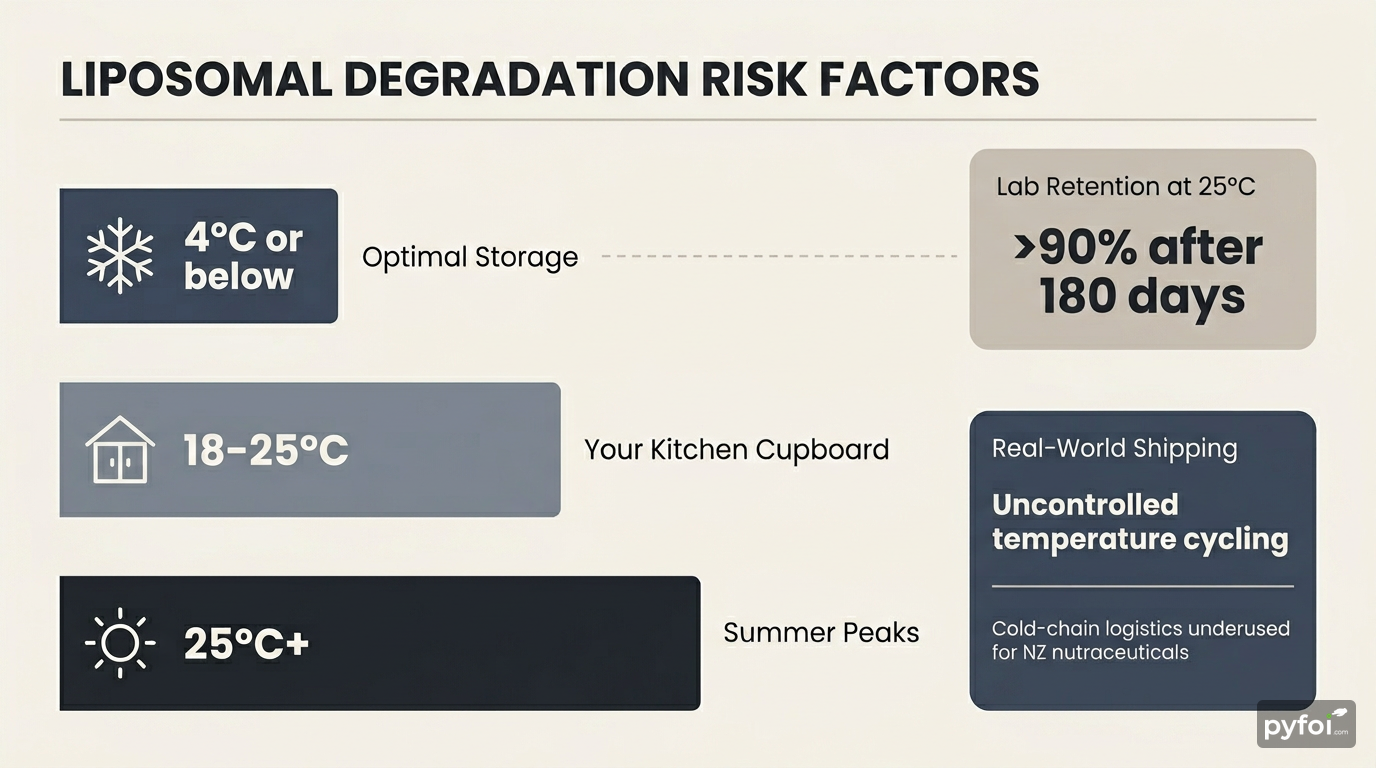
- Optimal storage is 4 degrees C or below [2][4]. Your kitchen cupboard sits at 18-25 degrees C on a good day, and higher in summer.
- Repeated temperature cycling - the kind that happens during shipping through uncontrolled warehouses - causes liposomes to aggregate, fuse, and leak their contents [1][2].
- Products using unsaturated phospholipids, common in soy-derived lecithin formulations, are more vulnerable to oxidative degradation [1].
- A stability study found well-formulated liposomal vitamin C retained greater than 90% content after 180 days at 25 degrees C [6] - but that was under controlled laboratory conditions, not a shipping container crossing the Pacific in summer.
The majority of liposomal products sold in New Zealand are imported without cold-chain logistics. DHL has noted that cold-chain pharmaceutical logistics are underused for nutraceuticals in this market [5].
What does degraded actually mean for your body?
Here is where this shifts from a waste-of-money problem to a health concern. When phospholipid membranes oxidise, they do not simply become inactive. They produce malondialdehyde and other reactive carbonyl species - compounds that are mildly toxic and contribute to oxidative stress [1][3]. The exact opposite of what you bought the supplement to do.
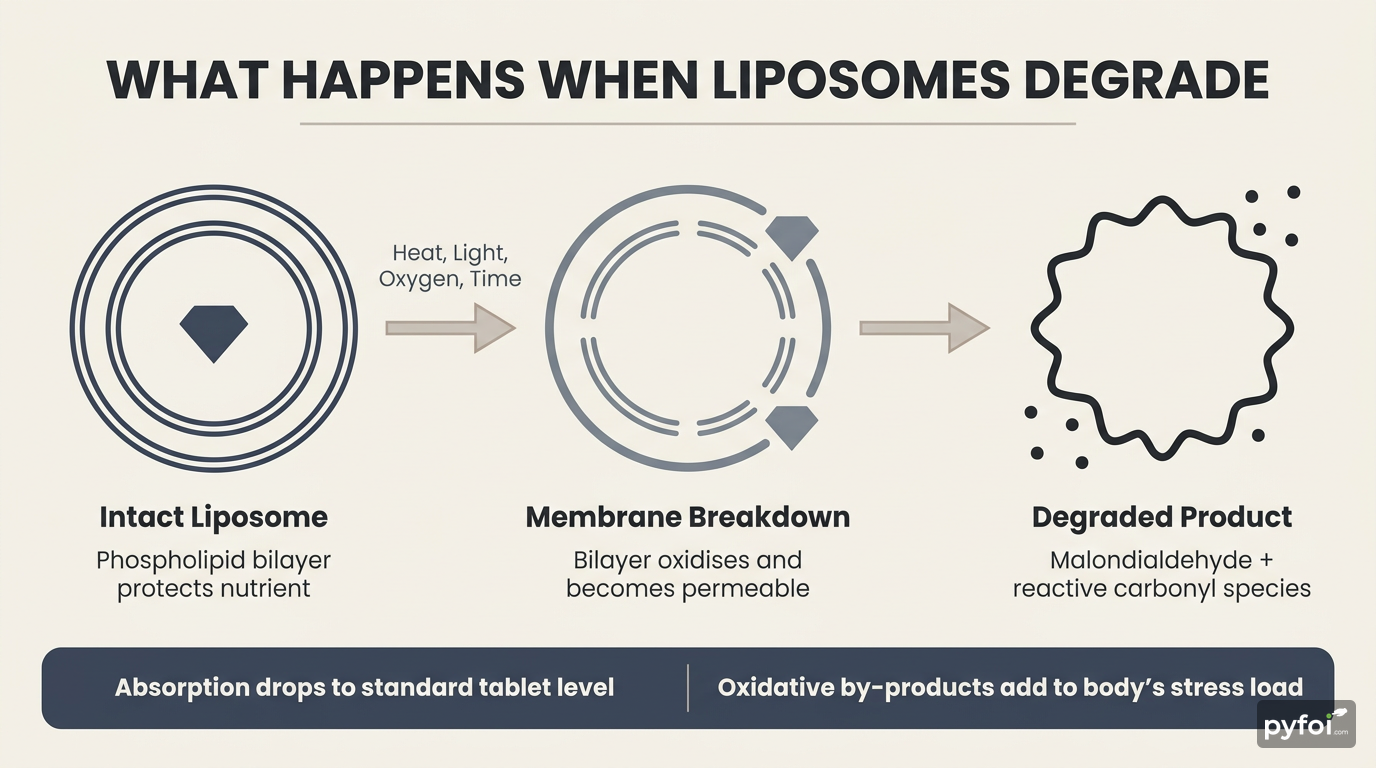
Imagine you have been taking a liposomal vitamin C supplement through winter to support your immune system. You stored it on the bench, as the label suggests is fine. Unknown to you, the liposomes broke down weeks ago. You are now swallowing a degraded emulsion that delivers no better absorption than a standard tablet - plus trace amounts of oxidation by-products adding to your body's oxidative burden. You paid more to get less, and potentially introduced something mildly harmful in the process.
Nothing on the label warns you. The liquid does not change colour or taste until oxidation has advanced significantly [1][2]. There is no visual cue, no smell, no expiry countdown for liposomal integrity.
What should you look for before buying?
Use these filters to reduce your risk of buying a product that has already degraded:
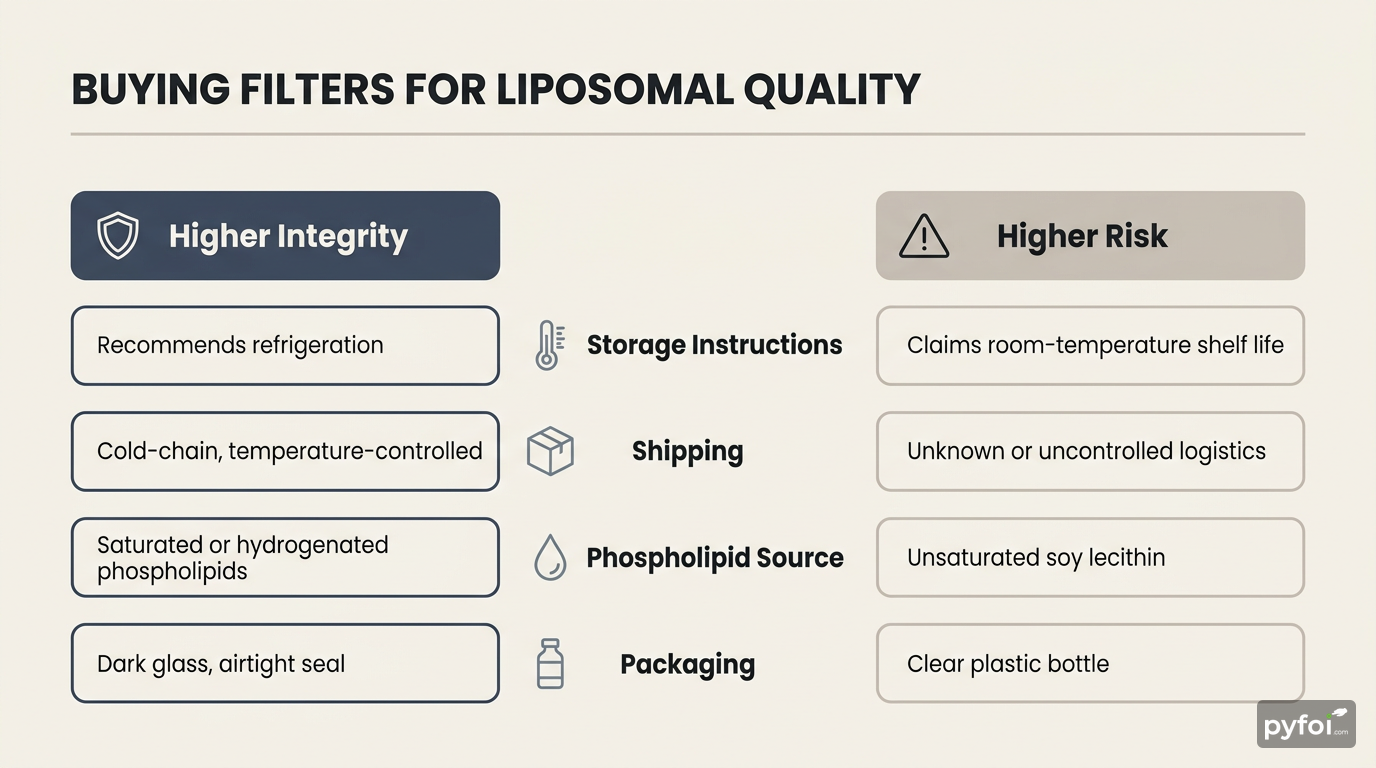
- Storage instructions: Does the brand recommend refrigeration? Products that require cold storage are more likely formulated with stability in mind. Brands claiming unlimited room-temperature shelf life deserve scepticism.
- Cold-chain shipping: Was the product shipped under temperature-controlled conditions? Ask the retailer. If they do not know, the answer is probably no.
- Phospholipid source: Saturated or hydrogenated phospholipids resist oxidation better than unsaturated soy lecithin [1].
- Packaging: Dark glass or opaque bottles with airtight seals protect against light and oxygen. Clear plastic offers minimal protection.
How to protect what you have already bought
Refrigerate immediately. Regardless of what the label says, store liposomal supplements at 4 degrees C or below once opened [2][4]. This slows oxidation and extends structural integrity.
Use it quickly. Do not stretch a bottle over six months. The longer it sits, the more degradation occurs - even refrigerated.
Buy local or direct where possible. A product manufactured in Australia or New Zealand has a shorter, more controllable supply chain than one shipped from Europe or North America through tropical shipping lanes.
Ask the brand directly. "What cold-chain protocols do you use for shipping to New Zealand?" and "What is the verified liposomal integrity at point of sale?" A brand that takes stability seriously will have answers.
Check for independent stability data. Some manufacturers publish stability reports showing encapsulation retention over time under specified conditions [6]. If a brand cannot provide this, you have no evidence the product you receive matches what left the factory.
Phospholipid encapsulation genuinely improves absorption - when the structures are intact. But "when intact" is doing a lot of heavy lifting. Until you can verify the product in your hand still contains functional liposomes, you are trusting the supply chain with your health investment. Refrigerate, ask questions, and buy from brands that treat stability as seriously as formulation.
You may also be interested in these independent articles
Sources
- Liposomes as Carriers of Bioactive Compounds in Human Nutrition - PMC, 2024
- Liposomal Guidelines: Liposome Stability, Storage and Shelf Life - EffePharm
- Emerging Mechanistic Insights into Liposomal Stability: Full Process Management - ScienceDirect, 2025
- Quicksilver Scientific Product Storage Guidelines
- Why New Zealand's Pharmaceutical Industry Needs Cold Chain Logistics - DHL
- Stability Report on Liposomal Vitamin C - PlantaCorp/Vitamax, 2024
© 2026 pyfoi. All rights reserved.