Example Independent Insights Articles
Here are some sample independent insight led articles
19 articles


Everything you need to know about liposomal delivery
Learn how liposomal delivery works, who benefits, and how to judge liposomal supplements in New Zealand.

The Hidden Tax on Every Supplement You Buy
Most shoppers compare supplements by milligrams and price per bottle. But the number that actually determines whether a supplement works - bioavailability - is nowhere on the label.
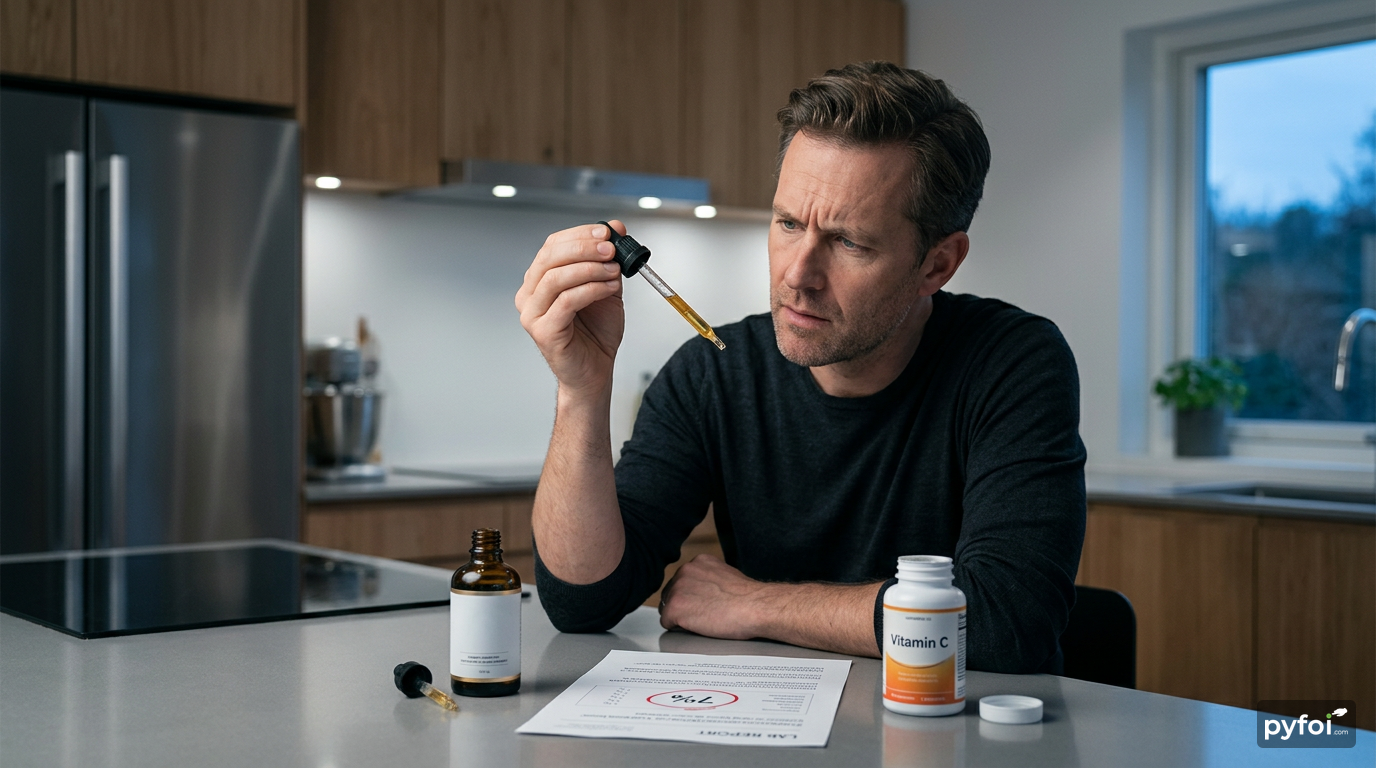
Paying Premium Prices for a Fake Liposomal Supplement?
Independent lab testing shows most liposomal supplements contain no real liposomes. Learn the four checks that separate genuine products from label-only fakes.

The Nutrient Gap Your Doctor Will Never Diagnose
A quarter of New Zealanders have inadequate zinc intake and a third are vitamin D deficient by winter. Learn why subclinical deficiency goes undiagnosed.
The Ageing Absorption Cliff After 50
After 50, your body absorbs less from every supplement you take. Learn why stomach acid loss, PPIs, and enzyme decline create a hidden nutrient gap.

Your Gut Is Quietly Sabotaging Your Supplements
64% of New Zealand adults have gut symptoms that silently reduce supplement absorption by 30-60%, making format choice more important than brand or dose.

Supplement Stacking Trap: Why More Is Less
Taking multiple supplements together creates absorption conflicts that reduce nutrient uptake. Learn how mineral competition wastes money and what formats avoid it.

The Start-Stop Supplement Trap That Costs You Thousands
Millions of supplement users quit because they feel nothing - then restart months later. The problem isn't the nutrient. It's how little of it your body ever absorbed in the first place.
Why Doubling Your Supplement Dose Is Not Doubling Your Results
Your body hits an absorption ceiling on most standard supplements. Escalating dose wastes money and delivers near-zero extra nutrient to your bloodstream.

Are You Trusting Regulations That Do Not Actually Exist?
New Zealand's supplement regulations date from 1985 and contain no provisions for liposomal claims. Every quality claim on the bottle is self-declared, with no pre-market approval and only complaint-driven enforcement.

The Double Deficit Hiding in New Zealand's Clean, Green Food
New Zealand's volcanic soils are naturally low in selenium, zinc, and iodine - meaning food grown here starts nutritionally behind. Standard supplements then fail to close the gap, creating a compounding deficit most Kiwis never see.

Is Your Liposomal Supplement Already Dead?
Liposomal supplements degrade through heat, light and oxidation before you open the bottle. Learn how to spot degraded products and protect your investment.
Are You Paying Premium Prices for a Fake Liposomal Supplement?
Independent lab testing shows most liposomal supplements contain no real liposomes. Learn the four checks that separate genuine products from label-only fakes.
You have done your homework. You have read that liposomal delivery can boost vitamin absorption by 20-55% compared to standard supplements [8][9][10]. So you spend three to five times more on a bottle that says "liposomal," confident you are getting a superior product. But what if the word on that label is doing all the heavy lifting, and the liquid inside is doing almost none?
What If "Liposomal" Does Not Mean What You Think?
Most supplement shoppers assume a product labelled "liposomal" actually contains liposomes. Reasonable enough. But independent laboratory testing tells a different story: the majority of products marketed as "liposomal" contain no true liposomal structures at all [1]. What is inside is typically a slurry of sunflower lecithin mixed with the active ingredient, with no verified phospholipid bilayer vesicles encapsulating anything [1][2].
Think of it this way. A genuine liposome is a microscopic fat bubble, precisely engineered to wrap around a nutrient and carry it through your gut wall intact. What most brands sell is the equivalent of tossing oil and vitamins into a blender and calling it "encapsulated." The fat and the nutrient sit next to each other, but nothing is wrapped, protected, or delivered differently than a standard supplement.
The questions worth asking are not "is this liposomal?" but: has this product been verified by electron microscopy? What is the encapsulation efficiency? Does the brand publish third-party structural analysis?
The Numbers Behind the Label
The gap between marketing and reality is stark:
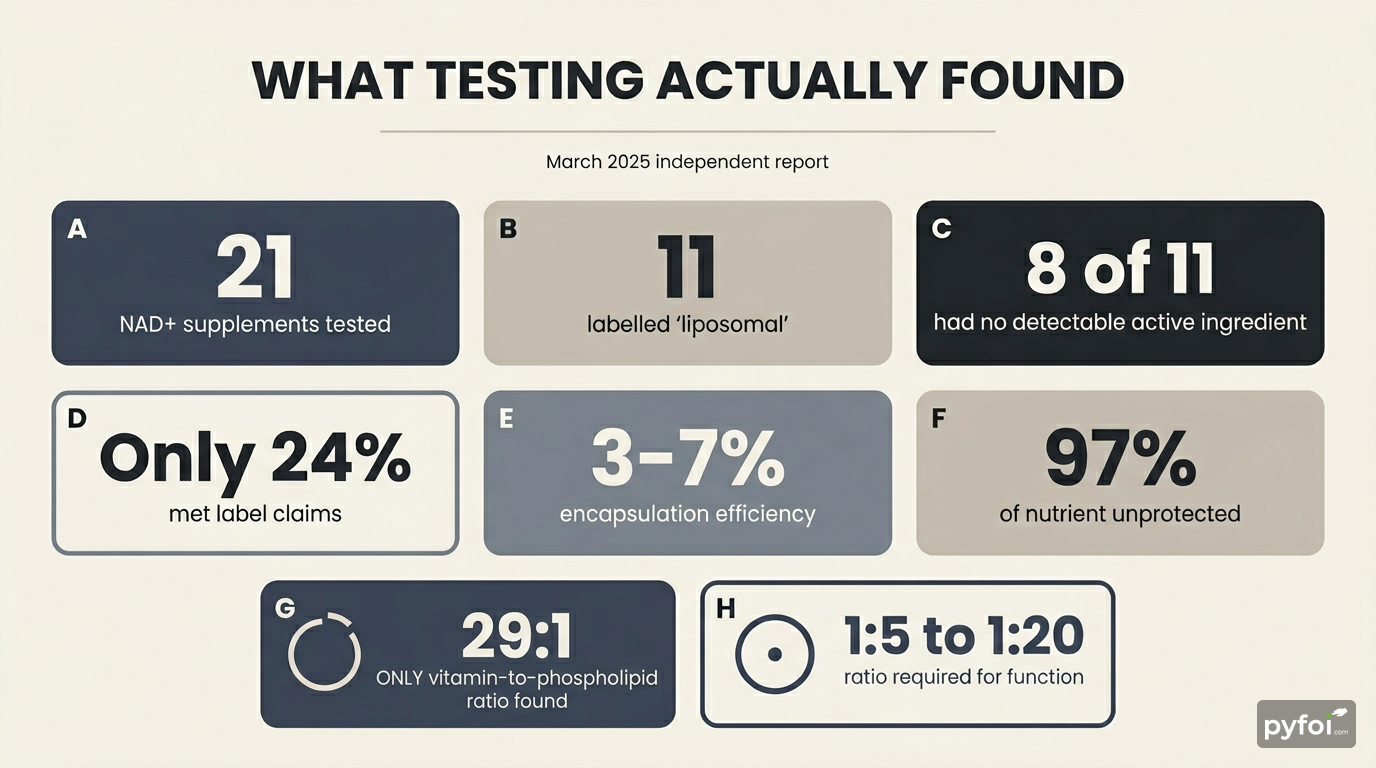
- A March 2025 report tested 21 top-selling NAD+ supplements. Of 11 labelled "liposomal," eight softgels contained no detectable active ingredient at all. Only 24% of tested products met their label claims [3].
- Encapsulation efficiency testing of commercial products has returned values as low as 3-7%, meaning up to 97% of the supposedly encapsulated nutrient had zero protection [1][3].
- The UK Advertising Standards Authority ruled that YourZooki, one of the most prominent liposomal vitamin C brands, had not provided conclusive evidence its product actually contained liposomes [5][6].
- Some products claim "50% liposomal vitamin C," figures that exceed what is physically plausible with current technology [4].
- Certain formulations use vitamin-to-phospholipid ratios of 29:1, far outside the 1:5 to 1:20 range needed for functional encapsulation [3].
You cannot verify any of this at home. Confirming real liposomal structures requires cryo-TEM electron microscopy or dynamic light scattering analysis [7]. No consumer has access to these tools, which is exactly why the problem persists.
What a Bad Choice Actually Feels Like
Imagine you have been taking a "liposomal" vitamin C supplement for six months, paying $45 a bottle instead of $12 for standard tablets. You chose it to support your immune system through winter or help with iron uptake. You feel good about the decision.
Then you discover your product's encapsulation efficiency was under 5%. All those months, the nutrient was absorbing at roughly the same rate as the cheap tablet you passed over. The premium bought better packaging and a persuasive label, nothing more. That is not just wasted money. It is misplaced trust in a product that traded on your willingness to invest in your health.
A Smarter Way to Evaluate Liposomal Supplements
Before you buy, filter any liposomal product through these four checks:
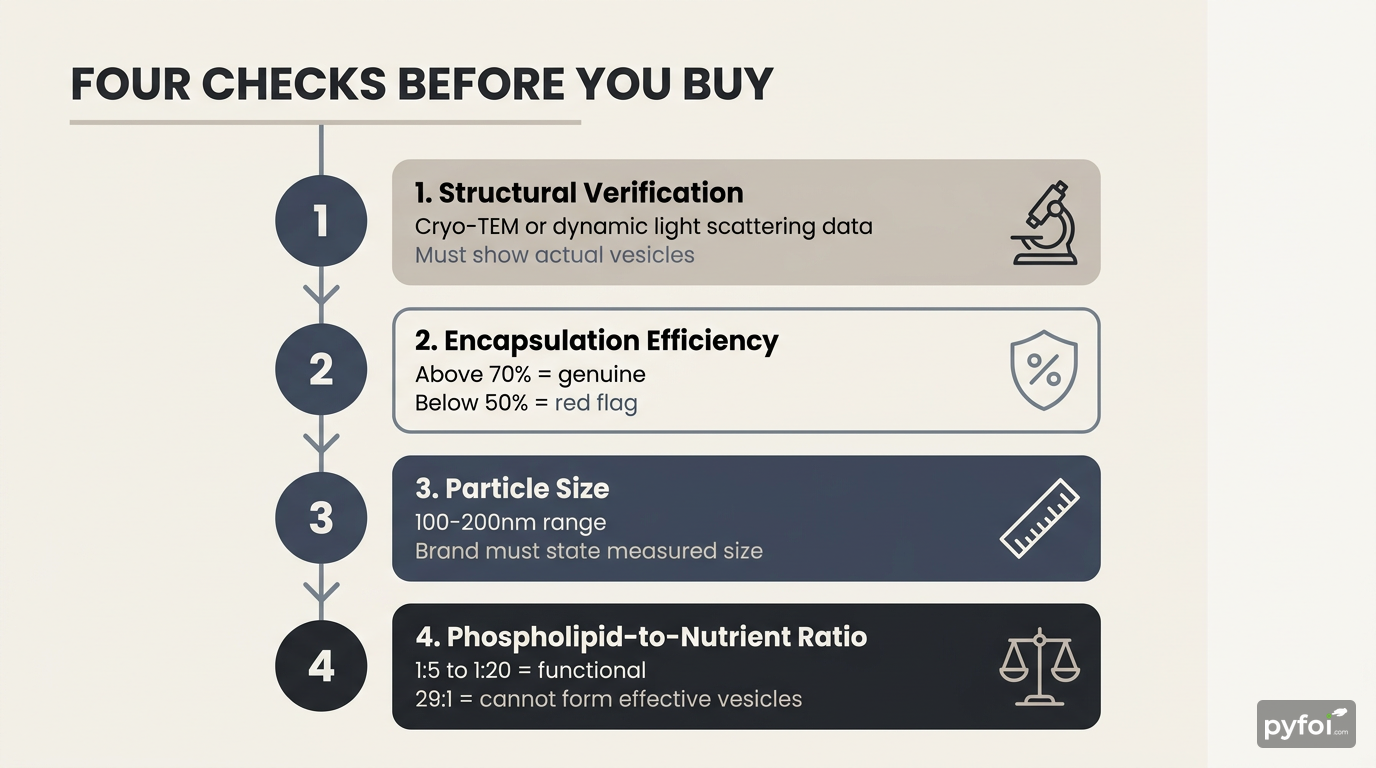
- Third-party structural verification: Does the brand publish cryo-TEM images or dynamic light scattering data showing actual vesicles? If not, you have no evidence liposomes exist in the product.
- Encapsulation efficiency: Genuine products should report rates above 70%. Below 50% is a red flag [1].
- Particle size disclosure: Functional liposomes fall in the 100-200nm range [1]. If the brand cannot state particle size, they likely have not measured it.
- Phospholipid-to-nutrient ratio: Look for ratios between 1:5 and 1:20. A 29:1 ratio simply cannot form effective vesicles [3].
Ask the retailer or brand: "Can you show me independent lab verification of liposomal structures?" Silence is an answer.
How to Actually Get What You Are Paying For
Start with verification, not marketing. Buy only from brands that publish structural evidence. A company with genuine liposomes will want you to see the data, because the technology is impressive when real.
Match format to your needs. Liquid liposomal products tend to maintain higher encapsulation integrity than capsules or softgels, because vesicles stay in suspension rather than being compressed. If you choose capsules, verification matters even more.
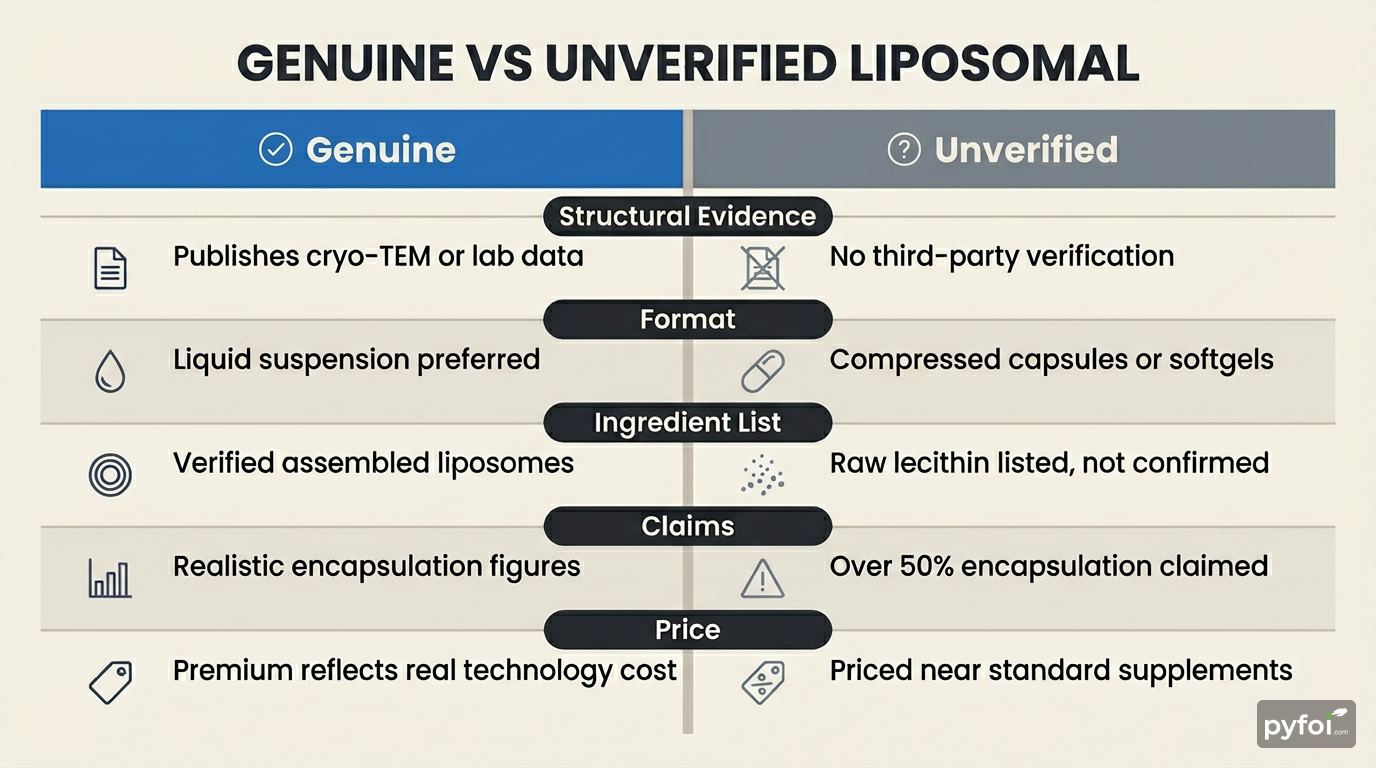
Do not be fooled by ingredient lists. Seeing "sunflower lecithin" or "phosphatidylcholine" on the label does not confirm liposomal delivery. These are raw materials. Without proper manufacturing, they remain unassembled ingredients, not functional delivery vehicles.
Watch for unrealistic claims. Products advertising encapsulation above 50% for the total formula deserve scepticism [4]. The physics of liposomal encapsulation set natural limits.
Consider the price signal. A genuine liposomal supplement will cost more, and that is fair. But if a "liposomal" product is priced only slightly above standard supplements, the economics do not add up. Real liposomal technology costs real money to produce.
The supplement industry in Australia and New Zealand has limited regulatory oversight on delivery-method claims. Until that changes, the responsibility falls on you to verify before you buy. Genuine liposomal technology works, and brands doing it properly are proud to prove it. Make them show the evidence before you hand over your money.
You may also be interested in these independent articles
Sources
- Real vs Fake Liposomes: Buyer's Checklist - Liposoma Technology
- How To Tell When A Product Is NOT Liposomal - Abundance and Health
- The NAD+ Liposome Problem: Supplement Science vs Marketing Claims - Nutraceutical Business Review, 2025
- Do liposomes make food supplements more effective? A chemistry expert explains common myths - The Conversation, 2023
- YourZooki Ltd ASA Ruling - UK Advertising Standards Authority
- Fake Liposomal Supplements: Popular Company Misled Consumers - Top Sante, 2024
- Cryo-EM Applications in Lipid Nanoparticle Characterization - Creative Biostructure
- Liposomal delivery enhances absorption of vitamin C into plasma and leukocytes: a double-blind, placebo-controlled, randomized trial - European Journal of Nutrition / PMC, 2024
- Pharmacokinetic Analyses of Liposomal and Non-Liposomal Multivitamin/Mineral Formulations - PMC / MDPI Nutrients, 2023
- Liposomal vitamin C may boost serum vitamin levels by 55% - NutraIngredients, 2024
© 2026 pyfoi. All rights reserved.