Example Independent Insights Articles
Here are some sample independent insight led articles
19 articles


Everything you need to know about liposomal delivery
Learn how liposomal delivery works, who benefits, and how to judge liposomal supplements in New Zealand.

The Hidden Tax on Every Supplement You Buy
Most shoppers compare supplements by milligrams and price per bottle. But the number that actually determines whether a supplement works - bioavailability - is nowhere on the label.
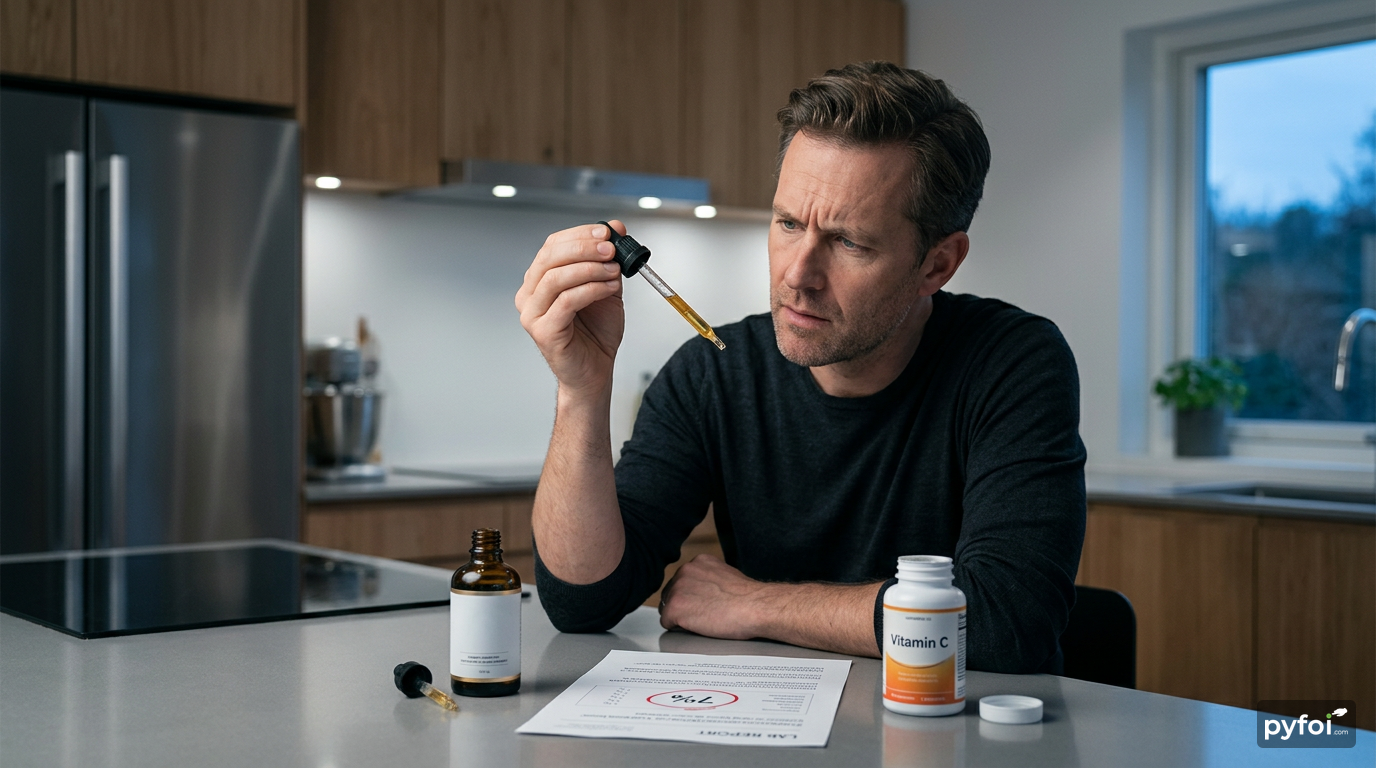
Paying Premium Prices for a Fake Liposomal Supplement?
Independent lab testing shows most liposomal supplements contain no real liposomes. Learn the four checks that separate genuine products from label-only fakes.

The Nutrient Gap Your Doctor Will Never Diagnose
A quarter of New Zealanders have inadequate zinc intake and a third are vitamin D deficient by winter. Learn why subclinical deficiency goes undiagnosed.

The Ageing Absorption Cliff After 50
After 50, your body absorbs less from every supplement you take. Learn why stomach acid loss, PPIs, and enzyme decline create a hidden nutrient gap.

Your Gut Is Quietly Sabotaging Your Supplements
64% of New Zealand adults have gut symptoms that silently reduce supplement absorption by 30-60%, making format choice more important than brand or dose.

Supplement Stacking Trap: Why More Is Less
Taking multiple supplements together creates absorption conflicts that reduce nutrient uptake. Learn how mineral competition wastes money and what formats avoid it.

Why Doubling Your Supplement Dose Is Not Doubling Your Results
Your body hits an absorption ceiling on most standard supplements. Escalating dose wastes money and delivers near-zero extra nutrient to your bloodstream.

The Start-Stop Supplement Trap That Costs You Thousands
Millions of supplement users quit because they feel nothing - then restart months later. The problem isn't the nutrient. It's how little of it your body ever absorbed in the first place.

Are You Trusting Regulations That Do Not Actually Exist?
New Zealand's supplement regulations date from 1985 and contain no provisions for liposomal claims. Every quality claim on the bottle is self-declared, with no pre-market approval and only complaint-driven enforcement.

The Double Deficit Hiding in New Zealand's Clean, Green Food
New Zealand's volcanic soils are naturally low in selenium, zinc, and iodine - meaning food grown here starts nutritionally behind. Standard supplements then fail to close the gap, creating a compounding deficit most Kiwis never see.

Is Your Liposomal Supplement Already Dead?
Liposomal supplements degrade through heat, light and oxidation before you open the bottle. Learn how to spot degraded products and protect your investment.
The Nutrient Gap Your Doctor Will Never Diagnose
A quarter of New Zealanders have inadequate zinc intake and a third are vitamin D deficient by winter. Learn why subclinical deficiency goes undiagnosed.
What if you are not sick, but not actually well either? A quarter of New Zealanders have inadequate zinc intake. A third are vitamin D deficient by winter's end. More than 80% of aged-care residents fall short on calcium, selenium, magnesium, and vitamin B6 [1][2][3][4]. These are not edge cases - they are the norm. And almost none of these people will receive a diagnosis, because they sit in a grey zone medicine was never built to detect.
Are You Solving the Wrong Problem?
Most people think about nutrition in binary terms: either you are deficient and unwell, or you are fine. Your GP tests for scurvy, anaemia, rickets - the sharp end of deficiency. But the space between clinical deficiency and optimal nutrition has no name on a lab report and no treatment pathway.
The real question is not "am I deficient?" It is "am I getting enough to protect my long-term health, or just enough to keep the lights on today?"
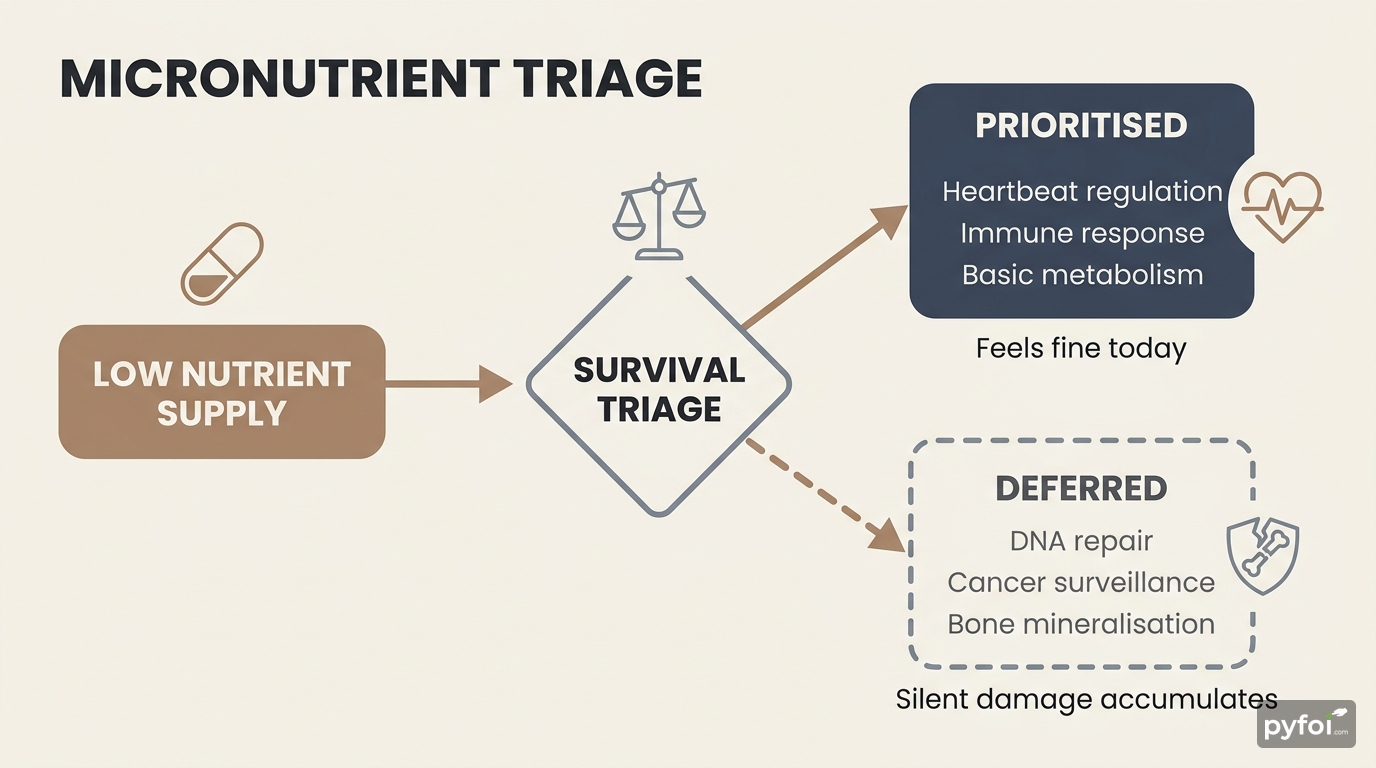
This matters because of triage theory, published by biochemist Bruce Ames in the Proceedings of the National Academy of Sciences. When your body runs low on a micronutrient, it fuels enzymes needed for immediate survival while shutting down those responsible for DNA repair, cancer surveillance, and bone mineralisation [5][6]. You feel fine today. The damage accumulates silently for decades.
Instead of asking "do I need supplements?", ask: which nutrients am I likely short on? Is my current supplement actually closing the gap? And what is the real cost of staying in this grey zone?
What Falling Short Actually Costs
The toll of subclinical deficiency is far larger than most people realise:
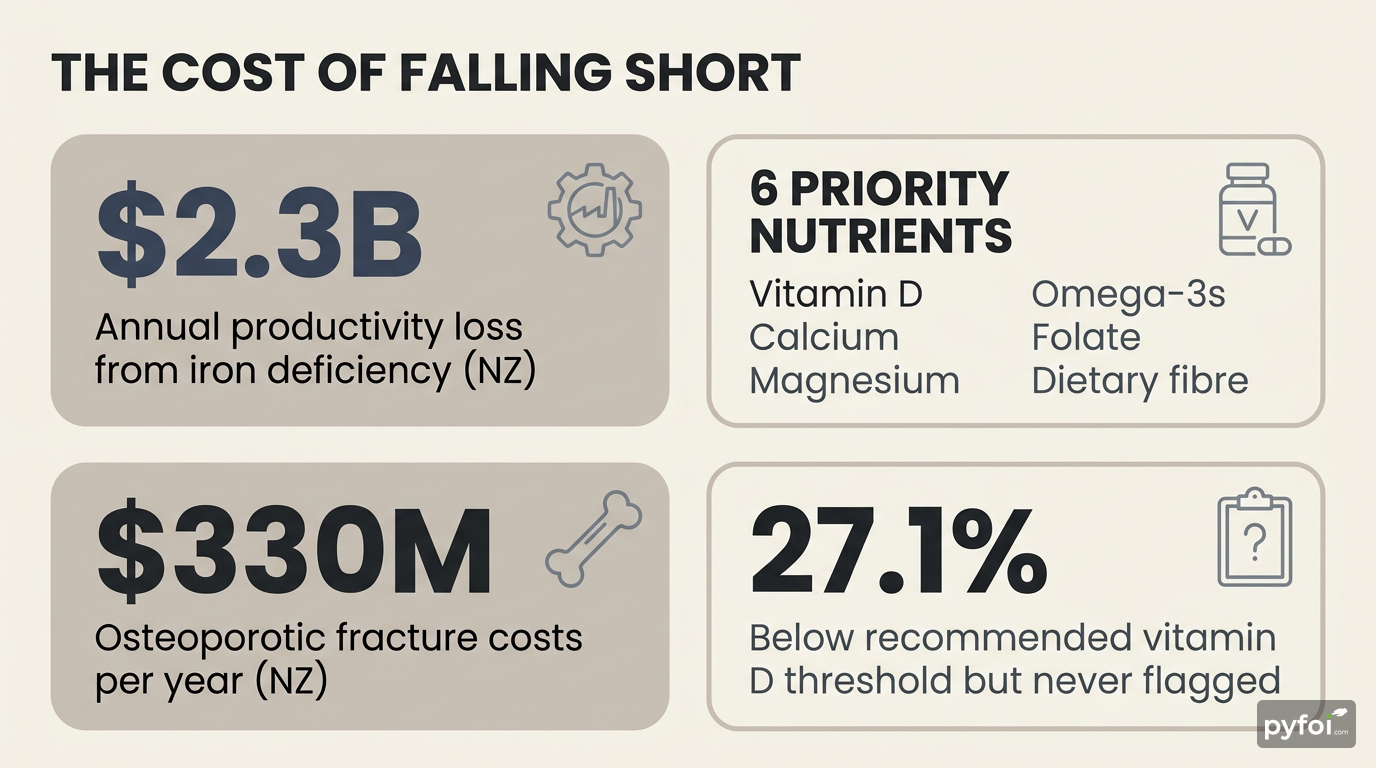
- Iron deficiency alone costs New Zealand roughly $2.3 billion in annual productivity losses [16].
- Osteoporotic fractures cost the NZ healthcare system $330 million per year, with inadequate calcium and vitamin D as primary drivers [17][18].
- A 2024 Frontiers in Nutrition study identified six priority nutrients of inadequacy across New Zealand: vitamin D, calcium, magnesium, omega-3s, folate, and dietary fibre [13].
- Only 4.9% of NZ adults are clinically vitamin D deficient, but an additional 27.1% sit below the recommended threshold [8]. That larger group will never be flagged by a blood test.
For every diagnosed deficiency, five or six more people are quietly underperforming.
The Slow Erosion You Cannot Feel
Imagine you take a daily multivitamin and assume your bases are covered. You are tired most afternoons, you catch every cold going around, and a small cut takes over a week to heal. None of these symptoms feel alarming enough to investigate.
Underneath, your body is running triage - prioritising your heartbeat and immune response today while deferring maintenance like bone density and cellular repair that protects you decades from now. The fatigue, brain fog, and mood dips are not personality traits. They are signals your nutrition is managing the present at the expense of the future.
Most people in this position believe they are already doing something about it.
A Smarter Way to Evaluate Your Supplements
Rather than defaulting to whatever multivitamin is on sale, assess your supplementation through three filters:
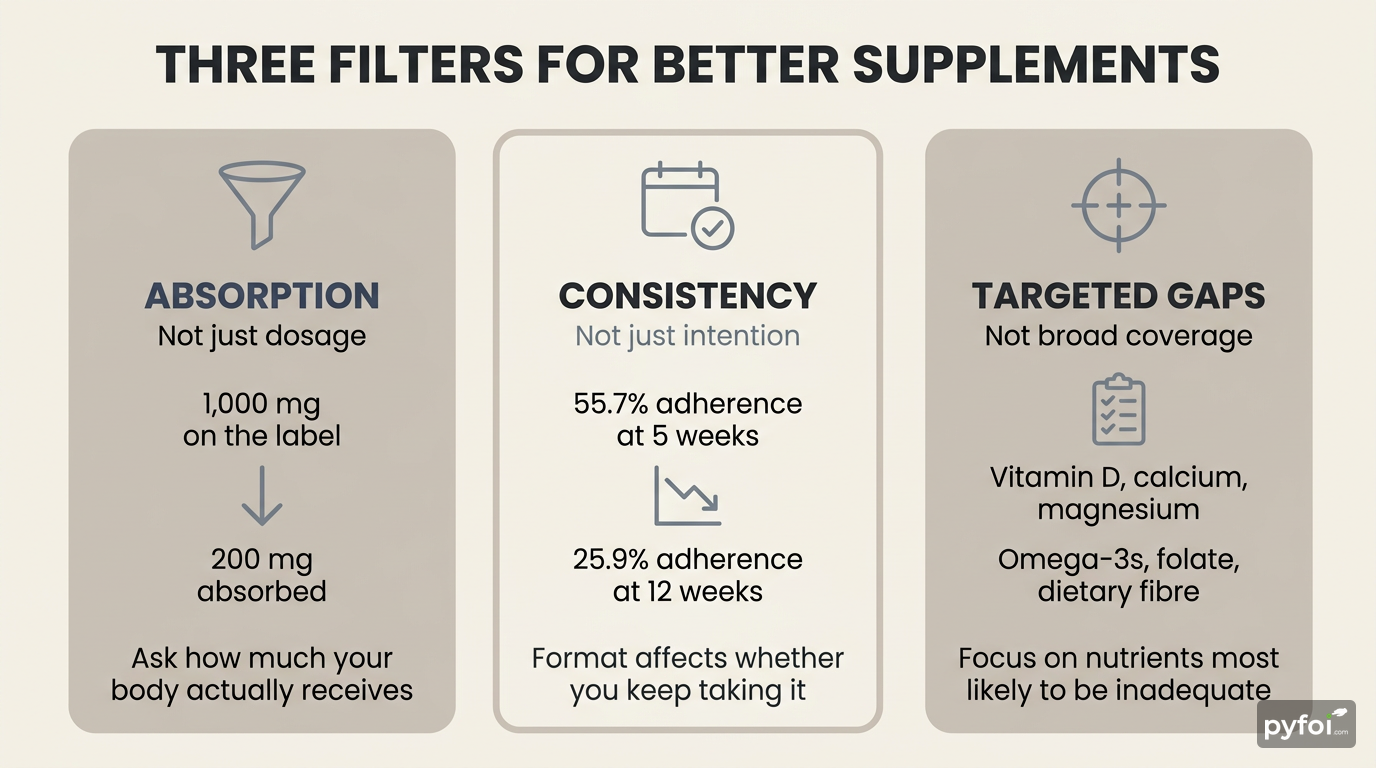
- Absorption, not just dosage: A capsule that delivers 1,000 mg on the label but only 200 mg into your bloodstream is not a 1,000 mg supplement. Ask how much your body actually absorbs.
- Consistency over intention: Supplement adherence drops from 55.7% at five weeks to just 25.9% by twelve weeks [9]. If a format is unpleasant or inconvenient, compliance collapses and so does the benefit.
- Targeted gaps, not broad coverage: Focus on the nutrients most likely to be inadequate in the NZ and Australian diet - vitamin D, calcium, magnesium, omega-3s, and folate [13] - rather than a scattergun approach.
How to Close the Gap for Good
Start with your risk profile. If you spend most of your time indoors, live south of Hamilton, are over 50, or eat a restricted diet, you are statistically more likely to sit in the subclinical zone for multiple nutrients.
Rethink the monthly cost question. Most people ask whether $30 to $60 a month is worth it [7]. But the real comparison is the cost of doing nothing: years of compounding fatigue, weakened immunity, and accelerated bone loss that eventually surfaces as a fracture or chronic diagnosis.
Prioritise formats that maximise absorption. Standard tablets and capsules lose much of their active ingredient to stomach acid and first-pass metabolism. Liposomal delivery wraps nutrients in phospholipid layers that protect them through digestion and increase the amount reaching your bloodstream [23][24]. If your supplement is not being absorbed, the money you spend is mostly symbolic.
Pick something you will actually take. Liquid or liposomal formats often have higher adherence because they are easier to take daily without the pill fatigue that drives most people to quit within three months.
Check in after 90 days. Energy, sleep quality, immune resilience, and wound healing are reasonable markers to track. If nothing shifts, your supplement may not be closing the gap.
Feeling "okay" is not the same as being well. Your body is extraordinarily good at compensating for nutritional shortfalls - until it is not. The question is not whether you can afford a better supplement. It is whether you can afford the silent compromise that comes from staying in the grey zone.
You may also be interested in these independent articles
Sources
- How to avoid NZ's top dietary deficiencies - Healthy Food Guide NZ
- Priority nutrients to address malnutrition and diet-related diseases in Australia and New Zealand - Frontiers in Nutrition, 2024
- New Zealand's soil lacks 3 essential minerals - are you deficient? - About Health NZ
- Inadequate Micronutrient Intakes: Exploring the Vitamin and Mineral Intakes and Food Sources of New Zealand Aged-Care Residents - Journal of Human Nutrition and Dietetics, 2025
- Low micronutrient intake may accelerate the degenerative diseases of aging through allocation of scarce micronutrients by triage - Ames, PNAS, 2006
- Prevention of Mutation, Cancer, and Other Age-Associated Diseases by Optimizing Micronutrient Intake - PMC, 2010
- Wrong Metric analysis - File 07, Insight 5
- Vitamin D Status of New Zealand Adults - Ministry of Health NZ / EHINZ
- Adherence to Oral Nutritional Supplements: A Review of Trends - Skinnars Josefsson, Food Science & Nutrition, 2025
- Priority nutrients to address malnutrition and diet-related diseases in Australia and New Zealand - Frontiers in Nutrition, 2024
- Iron deficiency and iron deficiency anemia in women - Scandinavian Journal of Clinical and Laboratory Investigation, 2014
- Current and future economic burden of osteoporosis in New Zealand - PubMed, 2011
- Osteoporosis & fractures - Osteoporosis New Zealand
- Liposomal delivery enhances absorption of vitamin C into plasma and leukocytes - PMC, 2024
- Pharmacokinetic Analyses of Liposomal and Non-Liposomal Multivitamin/Mineral Formulations - PMC, 2023
© 2026 pyfoi. All rights reserved.