Example Independent Insights Articles
Here are some sample independent insight led articles
19 articles


Everything you need to know about liposomal delivery
Learn how liposomal delivery works, who benefits, and how to judge liposomal supplements in New Zealand.

The Hidden Tax on Every Supplement You Buy
Most shoppers compare supplements by milligrams and price per bottle. But the number that actually determines whether a supplement works - bioavailability - is nowhere on the label.
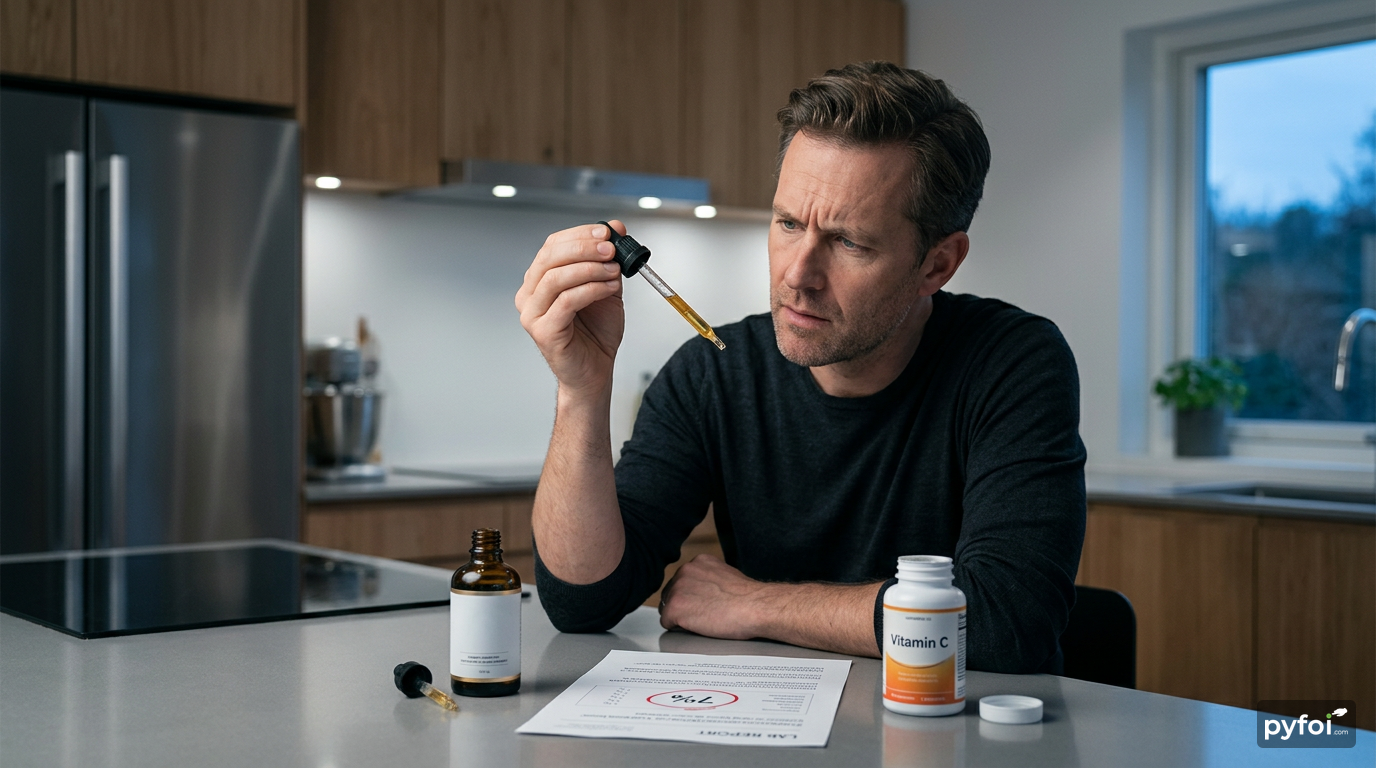
Paying Premium Prices for a Fake Liposomal Supplement?
Independent lab testing shows most liposomal supplements contain no real liposomes. Learn the four checks that separate genuine products from label-only fakes.

The Nutrient Gap Your Doctor Will Never Diagnose
A quarter of New Zealanders have inadequate zinc intake and a third are vitamin D deficient by winter. Learn why subclinical deficiency goes undiagnosed.

The Ageing Absorption Cliff After 50
After 50, your body absorbs less from every supplement you take. Learn why stomach acid loss, PPIs, and enzyme decline create a hidden nutrient gap.

Your Gut Is Quietly Sabotaging Your Supplements
64% of New Zealand adults have gut symptoms that silently reduce supplement absorption by 30-60%, making format choice more important than brand or dose.

Supplement Stacking Trap: Why More Is Less
Taking multiple supplements together creates absorption conflicts that reduce nutrient uptake. Learn how mineral competition wastes money and what formats avoid it.

The Start-Stop Supplement Trap That Costs You Thousands
Millions of supplement users quit because they feel nothing - then restart months later. The problem isn't the nutrient. It's how little of it your body ever absorbed in the first place.

Why Doubling Your Supplement Dose Is Not Doubling Your Results
Your body hits an absorption ceiling on most standard supplements. Escalating dose wastes money and delivers near-zero extra nutrient to your bloodstream.

Are You Trusting Regulations That Do Not Actually Exist?
New Zealand's supplement regulations date from 1985 and contain no provisions for liposomal claims. Every quality claim on the bottle is self-declared, with no pre-market approval and only complaint-driven enforcement.

The Double Deficit Hiding in New Zealand's Clean, Green Food
New Zealand's volcanic soils are naturally low in selenium, zinc, and iodine - meaning food grown here starts nutritionally behind. Standard supplements then fail to close the gap, creating a compounding deficit most Kiwis never see.

Is Your Liposomal Supplement Already Dead?
Liposomal supplements degrade through heat, light and oxidation before you open the bottle. Learn how to spot degraded products and protect your investment.
Why Doubling Your Supplement Dose Is Not Doubling Your Results
Your body hits an absorption ceiling on most standard supplements. Escalating dose wastes money and delivers near-zero extra nutrient to your bloodstream.
Sound familiar - more pills, same feeling?
Your vitamin C stopped feeling like it was doing anything. So you bumped from one capsule to two. Then maybe three. If some is good, more should be better, right?
Here is the uncomfortable truth: above a certain threshold, your body cannot absorb more of most standard supplements no matter how many you swallow. You are not building tolerance. You are hitting a biological ceiling - and spending more money to flush the excess straight through.
What if the problem is not your dose but your body's uptake limit?
Most people assume supplements work like food - eat more, get more. But nutrient absorption does not scale that way. Your intestines rely on specific transporter proteins to ferry vitamins into your bloodstream, and those transporters have a fixed capacity.
Think of it like a two-lane bridge at rush hour. Sending more cars does not make them cross faster. The overflow goes straight to your kidneys and out through urine.
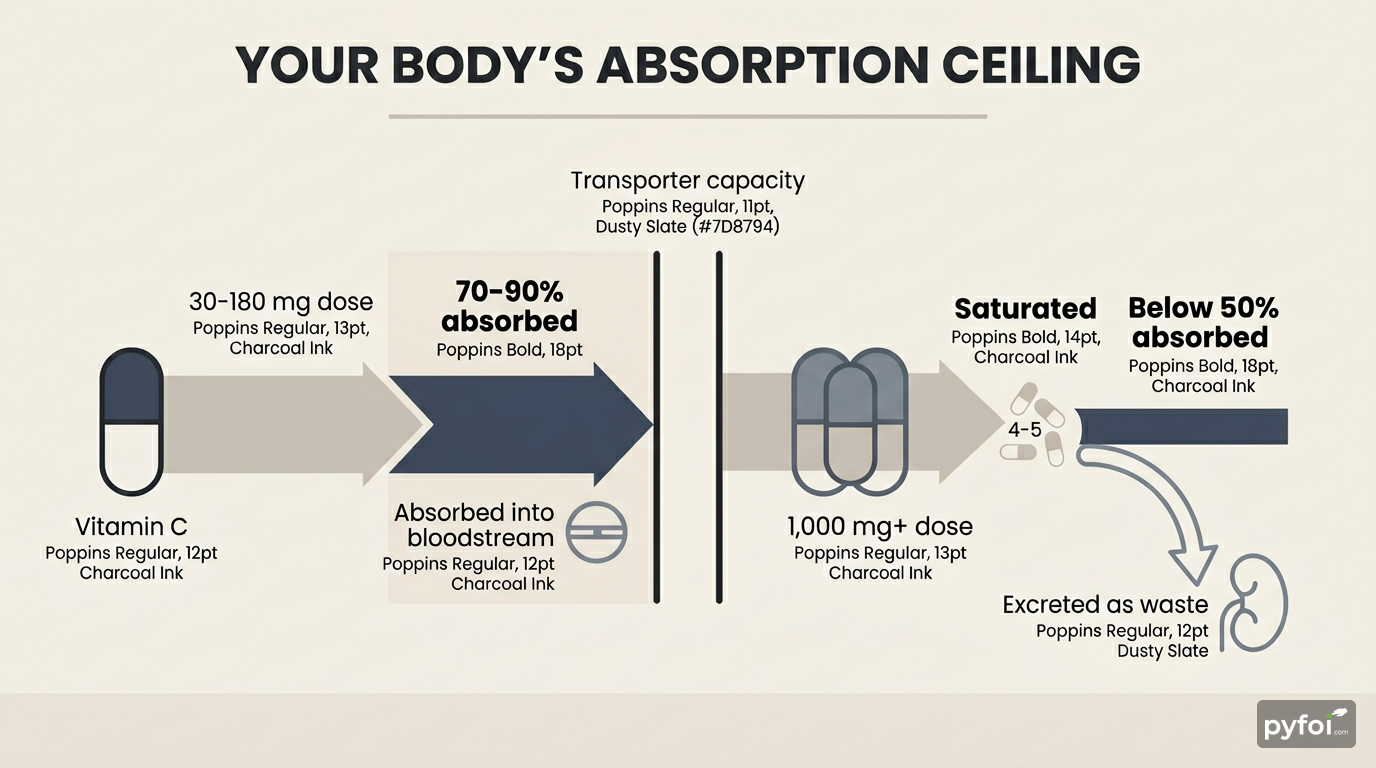
Vitamin C is the textbook example. At doses of 30-180 mg, your body absorbs 70-90%. Push above 1,000 mg, and absorption crashes below 50% [1][5]. Your intestinal SVCT1 transporters are saturated. The extra milligrams never reach your bloodstream.
So the real questions are: how much can my body actually use? Is a higher dose giving me more absorbed nutrient, or just more expensive urine? And is there a format that gets around this bottleneck?
The numbers behind the treadmill
Once you map out what happens at escalating doses, the waste becomes hard to ignore:
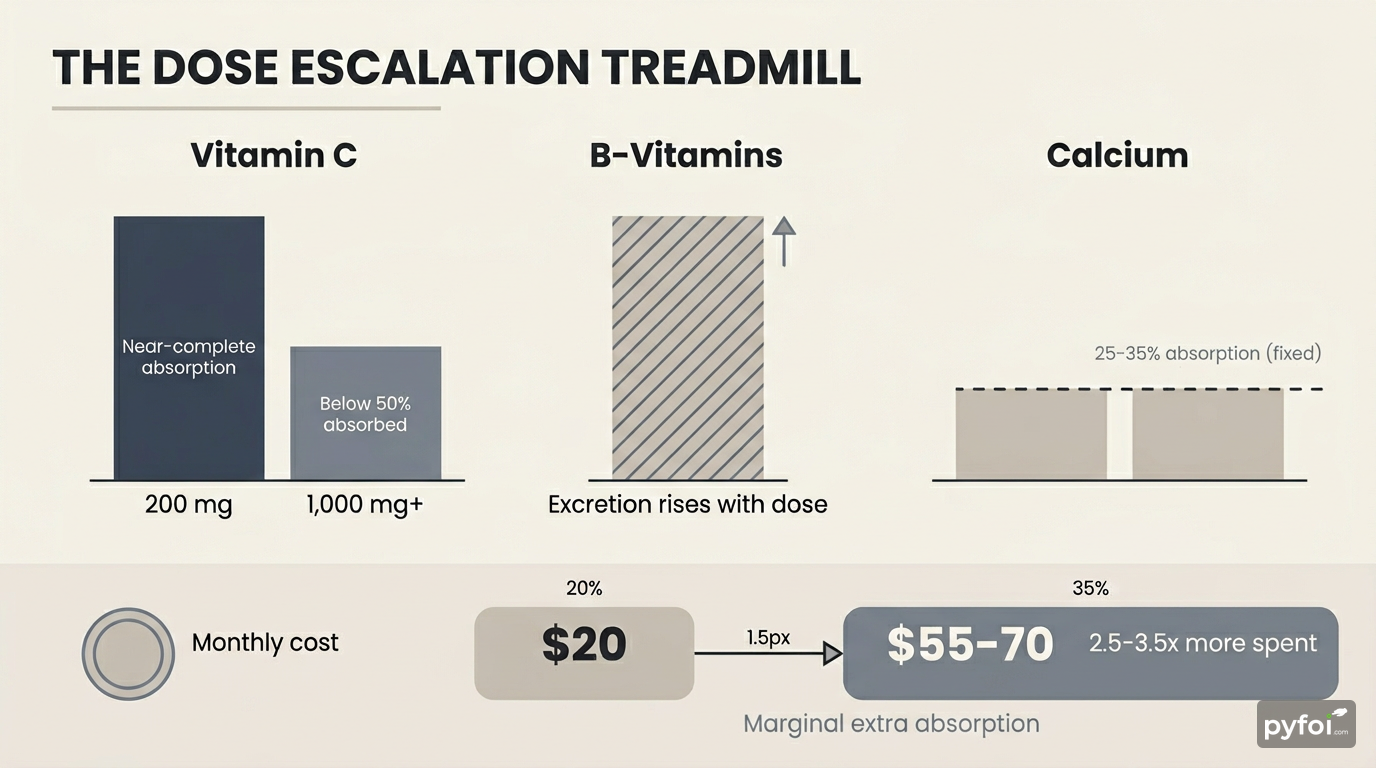
- Vitamin C absorption is near-complete at 200 mg but drops below 50% above 1,000 mg. Plasma concentrations plateau regardless of how much more you take [1][5].
- B-vitamin excretion increases in direct proportion to dose - the higher you go, the more you urinate out [6].
- Calcium absorption sits at a stubborn 25-35% efficiency no matter the dose [7].
- A consumer who escalates from a baseline $20/month supplement spend to $55-70/month across multiple products is paying 2.5-3.5 times more while gaining marginal additional absorbed nutrient [2].
You are not getting diminishing returns. You are getting almost no additional return.
What the dose treadmill actually costs you
Imagine you started supplementing vitamin C nine months ago at 500 mg daily. It seemed to help - fewer sniffles, a bit more energy. Around month four, the effect faded. So you doubled to 1,000 mg. By month seven, you pushed to 2,000 mg. Your monthly spend has tripled.
But your blood levels have barely moved. The transporters maxed out at roughly the same point they always do. You are paying $50-70 a month for the satisfaction of swallowing more capsules - not for more nutrient reaching your cells.
The real cost is not just financial. It is the quiet erosion of trust: the creeping suspicion that supplements do not work for you, when in reality you have been fighting a ceiling that no standard tablet can overcome.
How to get off the treadmill
Before reaching for a higher dose, run through these filters:
- Check whether your nutrient has a known absorption ceiling. Vitamin C, B-vitamins, and calcium all hit saturation points in standard oral form. More milligrams past that point is wasted money.
- Calculate cost per absorbed milligram, not cost per labelled milligram. If you absorb 40% of a 1,000 mg dose, your effective dose is 400 mg. Price accordingly.
- Ask about delivery format before dose. A format that bypasses intestinal transporter limits will outperform a dose increase every time.
What actually breaks through the ceiling?
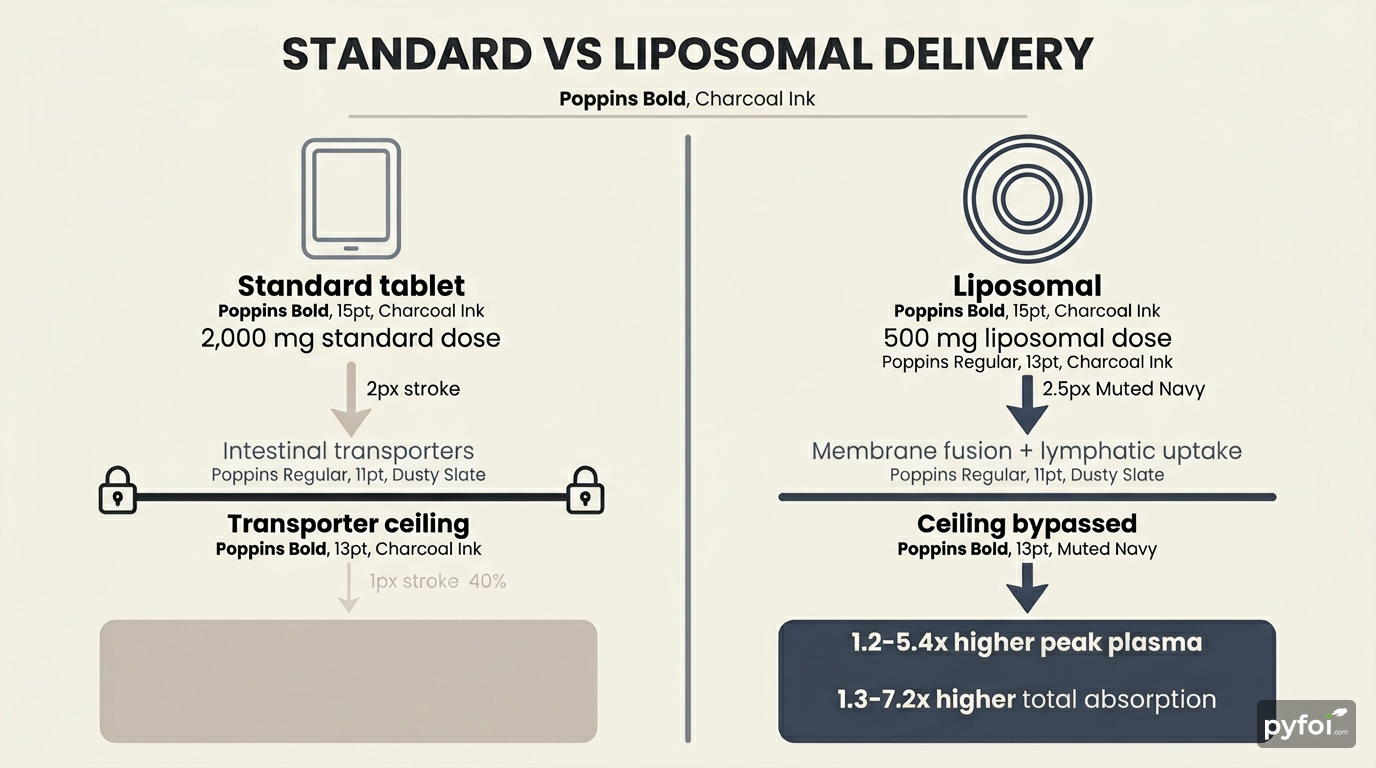
Understand why the ceiling exists. Standard tablets depend on intestinal transporter proteins. Once those are saturated, additional dose has nowhere to go. This is basic human physiology [1][5].
Consider liposomal delivery. Liposomal supplements use phospholipid layers to bypass transporter proteins entirely, absorbed through membrane fusion and lymphatic uptake - a completely different pathway [3][4]. A 2025 scoping review across ten clinical trials found liposomal vitamin C delivered 1.2-5.4 times higher peak plasma concentrations and 1.3-7.2 times higher total absorption compared to standard forms [10]. A 500 mg liposomal dose can deliver more nutrient to your bloodstream than a 2,000 mg standard dose [8][9].
Start lower, not higher. If you have been escalating dose, try stepping back to a moderate dose in a high-absorption format. You may spend less and absorb more.
Track outcomes, not milligrams. Pay attention to how you feel, not how much you swallow. If a lower-dose liposomal product delivers the same or better results as your escalated stack, that is your answer.
Reassess your whole routine. If you are taking multiple supplements at high doses, the interactions between them may further reduce absorption [2]. Simplifying to fewer, better-absorbed products can save money and improve results.
The instinct to take more when something stops working is understandable. But your body's absorption machinery does not care about your dose - it cares about its own capacity. Matching your delivery format to that reality is how you step off the treadmill and start getting what you are paying for.
You may also be interested in these independent articles
Sources
- Effects of Vitamin C Supplementation on Plasma and Urinary Vitamin C Concentration - PMC, 2017
- Hidden Cost analysis - File 04
- Liposomal delivery systems for intestinal lymphatic drug transport - PMC, 2016
- Beyond Traditional Supplements: The Science of Liposomal Encapsulation - WBCIL
- The Pharmacokinetics of Vitamin C - PMC, 2019
- Relationship Between Urinary Concentrations of Nine Water-soluble Vitamins and their Vitamin Intakes - PMC, 2014
- What is the absorption rate of supplements? - Ask The Scientists
- Liposomal delivery enhances absorption of vitamin C - PMC, 2024
- Liposomal vitamin C may boost serum vitamin levels by 55% - NutraIngredients, 2024
- Do Liposomal Vitamin C Formulations Have Improved Bioavailability? A Scoping Review - Carr, 2025
© 2026 pyfoi. All rights reserved.